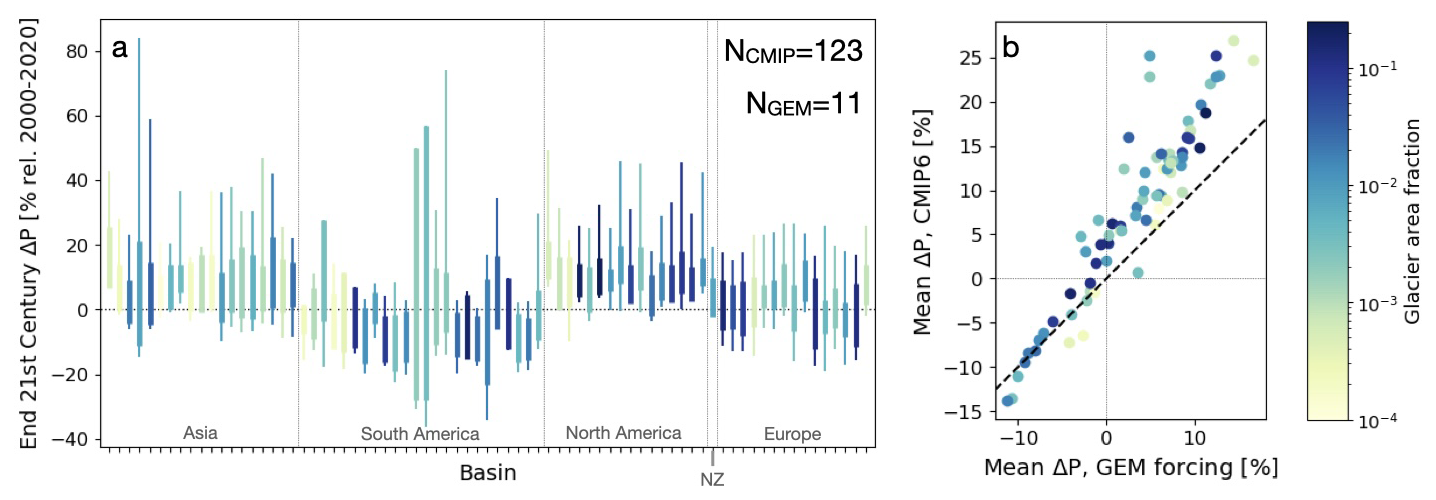
Lizz Ultee, who advised and inspired me back in 2022 when I was working on my master thesis on global glacier runoff and droughts, and co-authors have recently published a new paper on how glacier runoff buffers droughts during the 21-st century. The study combines our previous work and updates it, presenting an assessment of how glacier runoff buffers drought based on forcing from 11 CMIP6 models and three different global glacier models.
Find the full paper on https://tc.copernicus.org/articles/20/1339/2026/
How to cite: Ultee, L., Wimberly, F., Coats, S., Mackay, J., and Holmgren, E.: CMIP6 climate model spread outweighs glacier model spread in 21st-century drought buffering projections, The Cryosphere, 20, 1339–1361, https://doi.org/10.5194/tc-20-1339-2026, 2026.
Abstract
Drought risk is changing as the hydrological cycle responds to anthropogenic climate change. Projections of future drought risk used to inform water management would ideally be conducted at local scale, but local-scale projections demand local data and computational resources that are often not available. As an alternative, global-scale projections of glacier runoff and the hydrological cycle can provide important insights for the local scale, particularly when interpreted carefully. Here, we use an ensemble of 11 latest-generation (CMIP6) climate models to force three different global glacier models, and we examine changes in glacial drought buffering for 75 major river basins in the early, mid-, and late 21st century. Glacial drought buffering results are broadly consistent across glacier models. By contrast, we find that the spread in glacial drought buffering among different climate models is large and likely under-sampled compared with the full archive of suitable CMIP6 simulations (123 simulations from 28 models for the SSP2-4.5 scenario). This work highlights that, for downstream hydrological studies: (1) no one global glacier model is more suitable than another, and (2) analysing a representative ensemble of climate models is imperative. Our findings illustrate that differences in glacier model outputs that appear consequential to glaciologists may be less consequential for downstream impact metrics.